Showing posts with label Dictionary. Show all posts

25 April 2010

Brickspace Dictionary: Double-stud cheese SNOT

Double-stud cheese SNOT (n.) (technique)

The double-stud cheese SNOT technique has recently been discovered by Lego Monster. A simplified version of it had also been conceived by Moko.

The idea works by fitting cheese slopes sideways into the space between a tube (found at the centre of four studs, on the underside of a plate/brick) and the corner of the piece. The cheese slopes fit almost perfectly, with some friction and little damage to the parts. This is a fully legal technique.

There are two ways of utilising this geometry. The first is where you fit cheese slopes into the bottom of one plate and put another plate on top. The construction is stable, but the exact height between the two plates cannot be measured in plates or half-plates. There is also a gap between the plates.
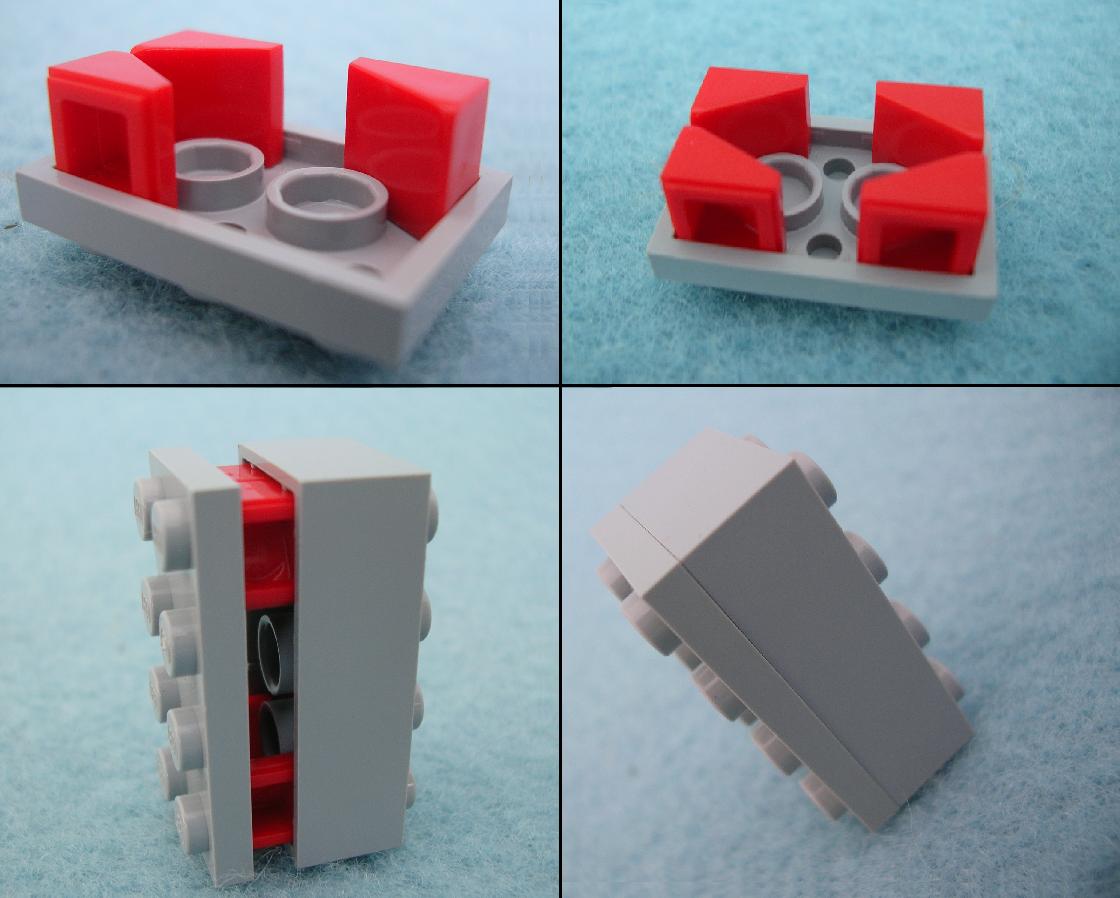

The second way of using the cheese slopes is by using a plate and a brick, as seen above. This option removes the gap, so there is a simple geometry: the resulting construction is 4 plates high. However, when using this technqiue, remember to fit the cheese slopes into the plate first, then fit that into the brick. Doing this the other way round will mean putting the plate will push the cheese slopes into the brick, and getting them out will be tricky.

This technique does not apply to 1xn bricks or plates, since they do not have large tubes, and don't have enough space in their underside. Contrary to what you may think, this technique can be used on a 2x2 brick/plate - but with two cheese slopes at opposite corners. This still provides ample clutch.

21 February 2010

Brickspace Dictionary: Five-Wide

Five-Wide (n.) (Five Wide)
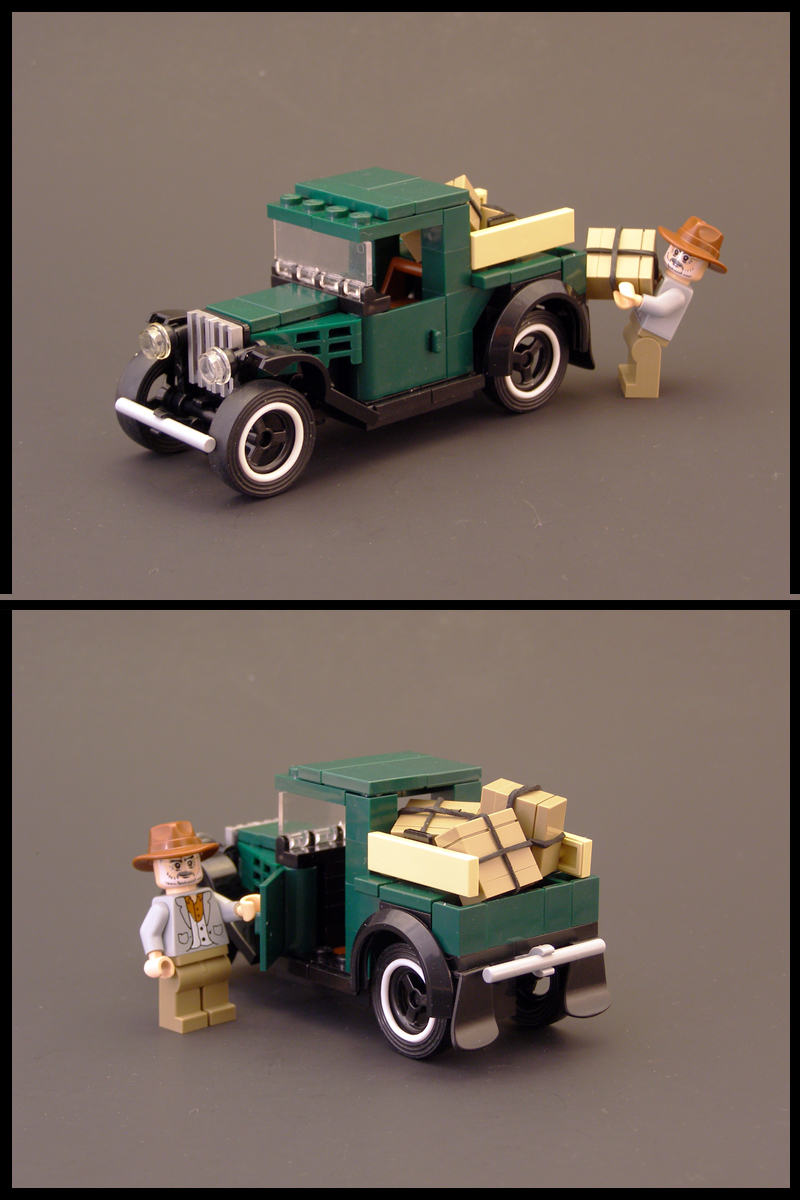
A five-wide (also 5-wide) is a type of minifig-scale vehicle. The Lego Group (TLG) produce cars that are four studs in width, and trucks that are six studs in width. Five-wide is an alternative to building with an even number of studs' width, but should only be used when it is needed, as it is not always necessary.

Builders choose to use a different width, five studs wide, for several reason. Firstly, it is more to scale than either 4-wide or 6-wide. Four-wide is considered too short because there is not enough space for two minifig-scale seats, and some more complex details are harder to achieve with only four studs' width to play with. Six-wide is thought of as too wide for a normal car, and is preferred for vans and trucks.

Five-wide also provides the builder with a challenge, whereas 4-wide may be considered 'too easy' to build in. Because of the odd number of studs, five-wide presents many problems when it comes to adding details to the car. It can help some features - such as a central ridge down the car's bonnet - but with other features, it is hard to find space to offset the studs. The innards of most five-wides are a mess of offset plates and complicated half-stud measurements.

"Is that car five-wide? Cool!"

"I built this car [in] five-wide, it was really hard"

Photo credit: Legohaulic 'Ford Model A Pickup' 


Need more 5-wides? Check out the Flickr Gallery!

17 August 2009

Brickspace Dictionary: SPUD

SPUD (abbrev.)
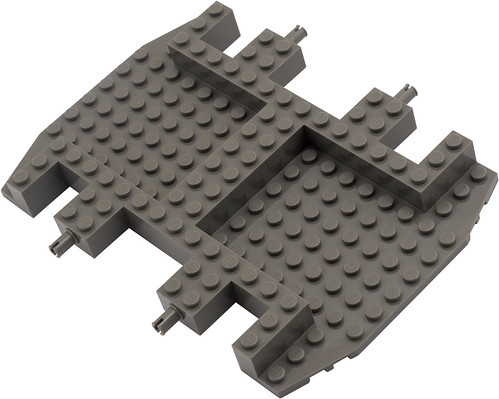
SPUD is a term used for large, pretty-much useless Lego parts. The abbreviation, standing for Special/Single Piece/Purpose Useless/UnLEGOish Design/Decorative, can be applied to a large range of Lego parts that has one specific purpose and which is therefore hard to integrate into a MOC. These tend to be vehicle chassis, like the one on the picture to the right.


A SPUD can sometimes (but not always) be a POOP as well. A POOP is a Piece (that can or should be made) Out of Other Pieces. The chassis above could definately be a POOP, but some SPUDs are so specialised that they cannot be POOPs. Similarly, a POOP could be a regular 1x8 brick: that could be made of two 1x4 bricks, four 1x2 bricks, or eight 1x1 bricks; but it is not a SPUD as it is extremely useful.

16 August 2009

Brickspace Dictionary: MISB

MISB (abbrev.)
MISB is an abbreviation used mainly amongst Lego collectors meaning 'Mint In Sealed Box'. It is the desired condition of an old Lego set that you are buying from the internet - still preserved in its original packaging.

Sometimes the abbreviation MIB (Mint In Box) is used instead. Some cynical builders say that, when used for Lego sets on eBay, MISB stands for 'Mangled In Substitute Box'.

15 August 2009

Brickspace Dictionary: Illegal Move

Illegal Move (n.) (Ill·e·gal_Move)
An 'illegal move' is when a building techniques unnecessarily stresses the elements it consists of. This can lead to warping or breaking of the bricks if they are held in that position over time.

There are several different types of illegal moves (and legal moves, too), most of which can be found in TLG's very own Powerpoint guide . The reason for an illegal move is mostly due to the receiving brick being smaller than the one being connected to it. Sometimes, though, a connection can be illegal because of the material of the pieces: the plastic polycarbonate (PC) is sometimes used instead of the usual ABS, and a tight PC-on-PC joint can be hard to undo.

Even the much-used 'secret Lego technique' paraplating (see right) is considered as an illegal move by TLG!

The Master Builders at LEGOLAND Windsor have a tradition that, whenever a builder performs an illegal move, they must 'buy the cakes' for all the others. In the general FOL community, however, illegal moves are regularly used.

14 August 2009

Brickspace Dictionary: Huey

Huey (n.) (Hu·ey)
The 'huey' is the regular 2x2 Lego System brick, found in almost all Lego sets and MOCs. Though properly known as a 2x2 Brick, the Huey has many other names. The name 'Huey' comes from the cockney rhyming slang of 'two-by-two-ey' (just like a Rory is a 'two-by-four-ey'). It is also known as a Louis, a name taken from The Brick Issue 16, which features a character called Louis who is a 2x2 brick. The Huey is sometimes called a Desmond, from Desmond Tutu (two-two, two-by-two).

There are several variations on Hueys, though they are not used often. For example, a 2x2 plate could be a 'flat Huey', and a 1x2 brick could be a 'thin Huey'.

Hueys offer little in terms of building techniques, but Hueys can be part of a Greco Joint , which is when a short Technic cross-axel is wedged in the tube on the underside of the brick. This, however, is hard to undo, and is an illegal move (it stresses the tube).

13 August 2009

Brickspace Dictionary: Grüschteling

Grüschteling (n.) (Grü·schtell·ing)
The word 'Grüschteling' is a German word used by German Lego fans. It is used to describe the distinctive sound made when you sift through a large bucket of Lego, trying to find the right piece.

The word has no English equivalent, but it is meant to be onomatopoeia, hence the sound of the word is the sound it describes (the 'rüsh' part sounds the most like it). It is pronounced 'Groo-shtel-ing' (without the umlaut). For the most accurate pronunciation, make a growly sound in the back of your throat for the R, and try to make an small O shape with your mouth for the Ü.

Grüschteling can also be used as a verb. For example, a family member might politely tell you to shut up by saying 'Quit grüschteling around!'.

Note: Does anyone know who made up grüschteling? I have something that says Ralph Hempel... is this correct?

12 August 2009

Brickspace Dictionary: The Fades

The Fades (n.) (The_Fades)
Usually used to describe minifigure heads, 'the fades' is a condition where most of the detail on a brick has faded off due to rough play.

The fades can affect any brick with printing on, such as minifigure torsos and old bricks with graphics. The fades usually takes several decades of play to be seen, but scratching or rubbing the pieces can quicken the rate of fading.

Some fading can also be achieved by Free Radicals - the Lego community's name for the big brick-fading device in the sky: the sun. If a brick is left on a windowsill, its colour can fade. White and blue bricks are the worst affected by free radicals.

11 August 2009

Brickspace Dictionary: Hands in Pockets

Hands in Pockets (n.) (Hands_In_Pock·ets)
The 'Hands in Pockets' is an old version of the Lego minifigure. It is so named because of its posture and the way its arms 'fade' into its torso, and it has no hands. This old minifigure, which came in many types, is also known as 'the extra', because it has no important features and it is like an extra on a TV programme - no details are seen, just the fact that they are there.

The HiP paved the way for minfigure-scale building. It introduced the minifig head, along with some minifig headpieces (including the 'police officer hat', which is still in use today). Sadly, in 1978, Lego designed the modern-day minifigure and the Extras were discontinued.

10 August 2009

Brickspace Dictionary: Earling

Earling (n.) (Ear·ling)
The Earling brick is a popular SNOT brick, which has two stud-sides and two under-sides. The name 'Earling' comes from its creator, but it is also known as a headlight brick because of its wide use as vehicle headlights in early Lego cars. Another name for it is a 'washing machine'.

The Earling brick is known for being used for SNOT. On its own, it has an annoying bottom rim (or 'bottom lip').  This means the stud is higher up the brick than it is in other SNOT bricks such as Travis (Dalek) and Davros parts. However, when two Earlings are put together along with a 1x1 plate, they make a neat SNOT solution (see below).

The 1x4 SNOT brick (see below) is named the 'laundrette' because it looks like a set of Earling 'washing machine' bricks all in a row. It is, however, more similar to the Travis brick because it has no rim.

9 August 2009

Brickspace Dictionary: Jumper

Jumper (n.) (Jum·per)
The jumper, or jumper plate (sometimes offset plate) is a unique brick in Lego System which enables stud measurements to be calculated in halves.

The brick, measuring 1x2x1/3, has a single stud in the middle. This offsets the stud measurement by one half-stud, an action sometimes called 'jumping'.

Jumper plates only offset in the stud-x or stud-y axes, but not simultaneously. This can be remedied by placing a jumper plate on two other jumper plates (see below).

Though the jumper plate does not have a real opposite, the 2x2 coupling plate can be used to take a 'jumped' brick from below (see below).

26 April 2009

Brickspace Dictionary: n x n x n

n x n x n (n.)
When measuring Lego bricks, we usually use the n x n x n system. This is much like normal measurements in which we provide the width x length x height of the brick, though sometimes the height is not required.

Most Lego bricks and plates can be classed as either 1xn or 2xn. In these examples, n could be any number. So 1xn means any brick that has one of its measurements (apart from height) as 1. This could be a 1x2 brick, a 1x4 brick or even a 1x16 brick! Similarly, 2xn bricks can have any length, but have to have a width of 2 (we usually put the shortest measurement as the width, but in the case of square (eg. 2x2) bricks, it doesn't matter).

This measuring system has a flaw, however: the units of width and length (sometimes shown by (a square)) are not the same as the unit of height (sometimes shown by (a diamond)). However, they can be interchanged using the 5:6 ratio, which is that every 5 brick height units equals 6 horizontal stud units.

You may often see a brick has a height of 2/3 (eg. 2 x 2 x 2/3). This is the only height measurement <1, because for every one height unit, three plates can take its place. Thus, 2/3 means that the brick is two plates high: say, for example, a cheese wedge. As I said, this is the only fraction measurement: 1/3 would just be a plate, and 3/3 is a whole, a 1.

The width and length measurements can also be fractions, though only 1/2s. If you use a jumper plate (a 1 x 2 plate with a single stud in the middle of it), you can offset the length or width by 1/2.

24 April 2009

Brickspace Dictionary: Joe Vig

Joe Vig (n.) (Joe Vig)
Joe Vig is a minifigure thought up by Mike Crowley, Nelson and Patrick Yrizarry. He is a common figure used in Vignettes who is always in danger.

Crowley and the Yrizarrys' first idea was to have 'Joe Food', a minifigure which they would photograph in different restaurants and post the pictures on LUGNET. They then changed the name to Joe Vig ('Vig' being short for 'vignette').

Joe Vig has brown hair, a red shirt, red trousers, and the first Ron Weasley face. Other hats and accessories must be white to keep with the Joe Vig theme.

The first Joe Vig contest was held in June 2005 as Joe's popularity soared in the early years of the 21st century. A full list of Vignettes with Joe Vig in them can be found on the LUGNET page here .

Information for this article was taken from the official LUGNET article .

22 April 2009

Brickspace Dictionary: URPs

URP (abbrev.) (Ug·ly Rock Piece)
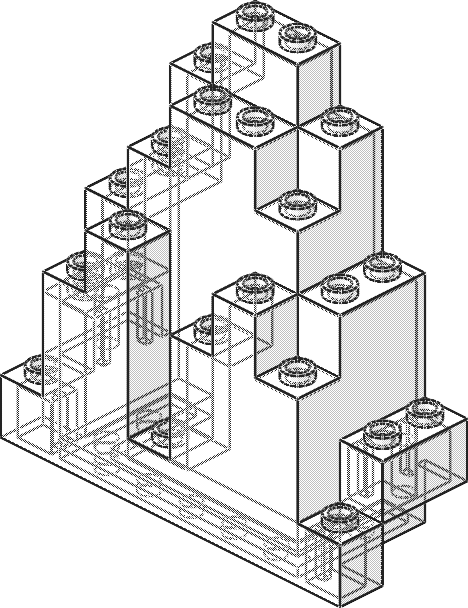
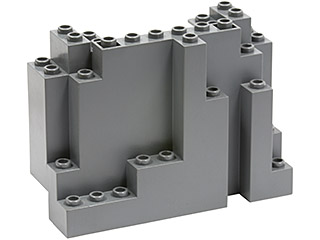
The URP family consists of two large hollow rocky pieces that are used commonly in landscaping and creating mountains. The URPs are also found in many Castle MOCs.

'URP' usually stands for Ugly Rock Piece, though it can also stand for Ugly Rock Part. They are 'ugly' because of their square, blocky and un-rock-like look. There are two types of URP:

LURP, standing for Little Ugly Rock Piece. These are roughly triangular in shape.


BURP, standing for Big Ugly Rock Piece. These are quite wide and square in their shape.


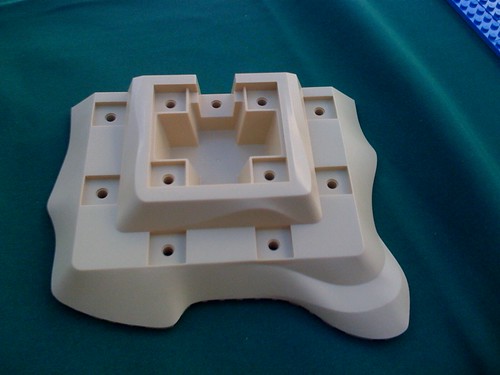
There is also the SLURP, which stands for Sandy Big Ugly Rock Piece. Used recently in a Pirates set as an island, the SLURP (named by Michael Huffman) has no studs and many circular holes to hold bricks with circular technic axels, which in turn can be connected to plates, bricks and other assorted bricks.

BURPs and LURPs are generally meant to be built upon with more bricks in the same colour:

20 April 2009

Brickspace Dictionary: BBC

BBC (abbrev.) (Bi·o·nicle Based Cre·ation)
The term BBC is used to signify a Bionicle creation. Though the abbreviation may also relate to the British Broadcasting Corporation, in the LOC it refers to a creation which uses Bionicle, Technic and some System bricks. BBCs are usually named with a mock-Toa name or a variation on a usual Bionicle name, such as that of a Bohrok or Rahi.

On the Bionicle fansite BZPower, there is a monthly contest held called BBC.

18 April 2009

Brickspace Dictionary: Cheese Wedge

Cheese Wedge (n.) (Cheese Wedge)
The Cheese Wedge, sometimes known as the Cheese Brick, or Cheese slope, is a relatively new addition to the slope family of Lego bricks.

The cheese wedge, so named because of its cheese-like shape and minifig compatibility, measures 1 x 1 x 2/3, meaning it is 2 plates tall.

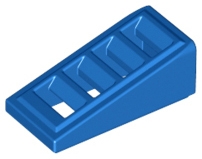
An addition to the cheese wedge is the cheese grater brick, named by AFOL Mike Yoder. The cheese wedge is a 1 x 2 x 2/3 slope and has a grate on it, making it look like a cheese grater. It was released in 2008.

16 April 2009

Brickspace Dictionary: Sigfig

Sigfig (abbrev.) (Sig·na·ture Fig·ure)
A Sigfig is a defining minifigure for you and your user in the Lego Online Commuinty. Sometimes called a 'sigfiggy', the abbreviation groups Signature and Figure (from minifigure) to create Sigfig. 'Sigfig' is usually spelt with a capital S or no capitals at all.

Sigfigs can be shown to the public on sheets such as the one to the right, which is Joris Blok's. On these sheets, MOCers outline the best points of their Sigfigs and what they mean.

On many forums you can add an 'avatar' of yourself. A Sigfig is just this: a minifigure representation of yourself that other users can recognise. Sigfigs do not necessarily have to resemble you: they can be whatever you want them to be.

The Sigfiggy Abuser's Club on MOCpages is a popular club which holds an annual competition to see who can abuse other users' Sigfigs in the best way possible, called the Darwin Awards.

14 April 2009

Brickspace Dictionary: Fleebnork

Fleebnork (n.) (Fleeb·nork)
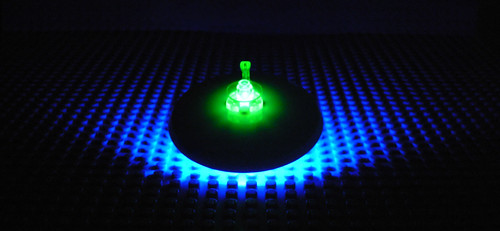
Fleebnorks are fictional Lego creatures that were popular at teh start of the 21st century. They consist of a 2x2 parabolic disc attached to a 'scorpion' part.

Fleebnorks eat through power couplings and any other metal and Lego space-related objects they can get their claws on. Currently the only way of stopping a Fleebnork is burning it with a plasma flamethrower.

Fleebnorks, sometimes abbreviated to 'Fleebs', make a distincitive sound like 'pleh'. They are usually trans. light green or yellow. If a Fleebnork does not keep with this colour scheme, they are called 'Pseudofleebs'

New Fleebs are being made up all the time, the most notable being the Pimpnork, a Fleebnork with a sliver shell and a black body.

Information on Fleebnorks taken from Fleebnork.com .

12 April 2009

Brickspace Dictionary: Dark Age

Dark Age (n.) (Dark Age)
Used mainly by AFOLs, 'Dark Age' is a popular phrase used to sum up a period in one's life when you were not interested in Lego or active in the Lego online forums and community. This mainly happens because a person is a fan of Lego as a child, then grows out of Lego when they go to University or get a job. They then rediscover Lego later, and become active in the LOC. The period when that person is not interested in Lego is called their dark age.

This can also mean a dark time when a MOCer is online, and when they only build one thing.

10 April 2009

Brickspace Dictionary: COW

COW (acr.) (Curved Out Wedge)
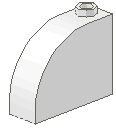
The acronym 'COW' is short for Curved Out Wedge. In the early 2000s, Lego started releasing curved versions of the classic straight slopes. Though they are much rarer than the slopes, they are used widely in MOCs as they offer a smoother, more interesting alternative to the usual straight slope.